Capital allowances and AIA: what SimpleCompanyTax supports
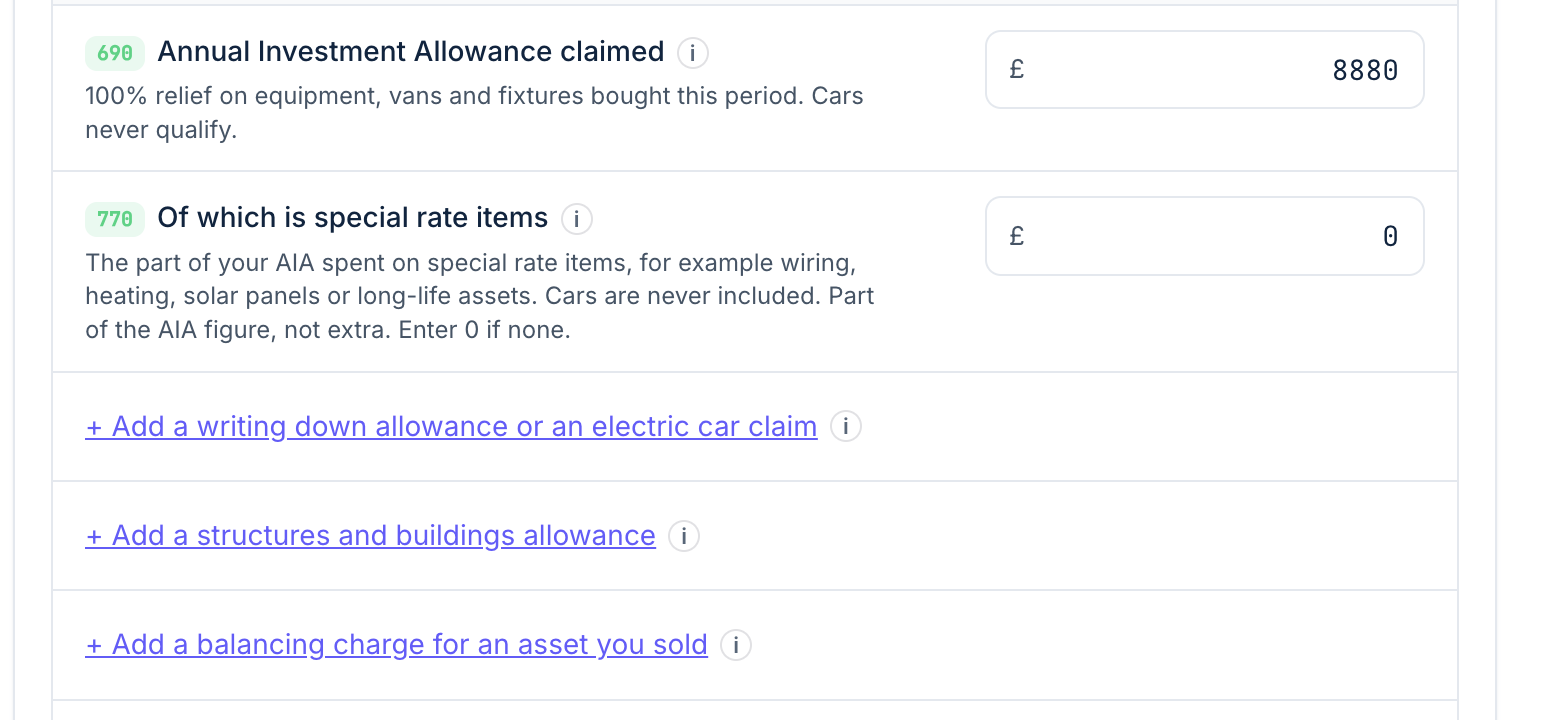
Short version. Enter each capital allowance you are claiming in the Tax adjustments section. Put Annual Investment Allowance in the AIA field, then open the matching link for any writing down allowance, electric car claim, structures and buildings allowance or balancing charge. Do not enter one combined capital-allowances total. We add the claims together and complete the relevant parts of the Corporation Tax return for you.
2. What capital allowances are
When your company buys something that lasts, such as a laptop, tools, office furniture or a van, tax relief is usually claimed through capital allowances rather than by deducting the purchase price as an ordinary running cost. Capital allowances reduce the profit on which the company pays Corporation Tax.
Your annual accounts may also contain depreciation for the same asset. Keep that depreciation in the separate depreciation field. We add it back when working out taxable profit, then deduct the capital allowances you enter. Do not put depreciation in the capital-allowances fields.
See HMRC’s overview of capital allowances for the underlying rules and records you need.
3. Enter Annual Investment Allowance
The Annual Investment Allowance, usually shortened to AIA, is the most common kind. It can give 100% relief on qualifying plant and machinery in the period it is bought. The limit is normally £1,000,000 for a 12-month period. A shorter Corporation Tax period has a proportionately smaller limit, which we check using your dates.
Typical qualifying purchases include computers, tools, machinery, office furniture and vans. Cars never qualify for AIA. Enter the AIA you are claiming in the Annual Investment Allowance field, not the asset’s depreciation and not a total that includes other types of allowance.
The field immediately below asks Of which is special rate items. This is the part of the AIA figure that relates to items such as wiring, heating, solar panels or long-life assets. It is part of the AIA figure, not an extra allowance. Enter 0 if none of your AIA relates to special rate items.
4. Other claims we support
A mixed claim is shown once in the computation total, with the first-year car allowance identified as a component. For example, £3,000 AIA plus a £500 first-year car allowance gives £3,500 total relief, not £4,000. See how allowance breakdowns are tagged.
Use the links below the AIA fields to open only the extra rows you need. SimpleCompanyTax supports these straightforward claims:
- Main pool and special rate pool writing down allowances. Enter the allowance you have calculated from each pool. We do not maintain the pools for you.
- A 100% first year allowance for a qualifying new low-emission or electric car. The vehicle rules depend on when the car was bought. Cars never go in AIA.
- Structures and buildings allowance. You need a valid allowance statement. Enter its qualifying expenditure and dates, and we calculate the ordinary 2% or 3% allowance for the period. We cannot file an enhanced 10% claim because it needs CT600M supplementary pages.
- Balancing charges. These may arise when the company sells an asset on which it previously claimed capital allowances.
We do not currently support full expensing or the 40% first year allowance introduced for qualifying expenditure from 1 January 2026. Those claims use different CT600 disclosures from AIA. Use AIA where it applies and where that is the claim the company is making. Otherwise ask an accountant to file the return rather than moving a different relief into an AIA or writing down allowance field.
For writing down allowances, the main pool rate is 18% a year before the April 2026 rate change and 14% afterwards. A period that crosses the change uses a hybrid rate. The special rate pool is 6% a year now. HMRC explains the current rates and pool rules in Work out your writing down allowances.
Read our company cars article, structures and buildings allowance article and balancing charges article for the extra information each claim needs.
5. If your first accounting period is longer than 12 months
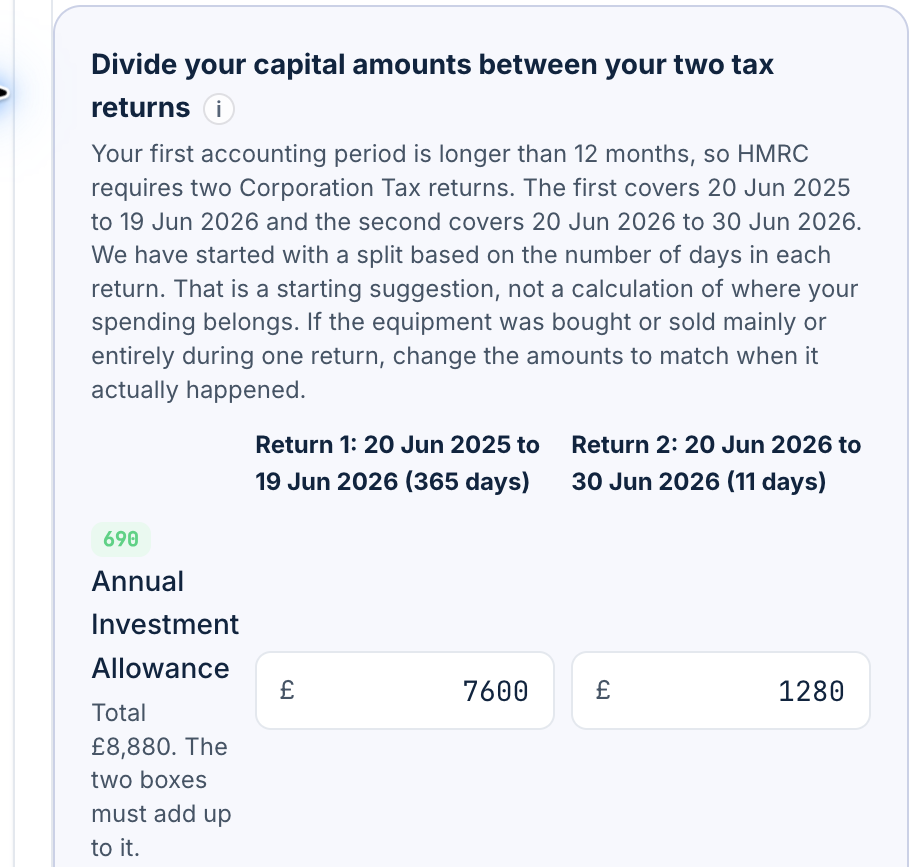
Companies House may accept one set of annual accounts covering more than 12 months, but a Corporation Tax accounting period cannot be longer than 12 months, so a company within the charge for that whole period files two Corporation Tax returns. SimpleCompanyTax shows the exact dates of both returns and asks you to divide capital amounts that belong to a purchase, sale or pool between them. (Where HMRC records show Corporation Tax starting later, because the company was dormant at the start of the period, there is a single return and nothing to divide. Your CT603 notice confirms which applies.)
We start with a split based on the number of days in each return. That is only a convenient starting point. It does not tell you which return legally owns the claim. Check the purchase or sale date in your records, then change the amounts so they match when the transaction actually happened. If an asset was bought entirely in the first return, for example, put its relevant amount in return 1 and 0 in return 2.
The two boxes on each row must add up to the total you entered above. We also show and check the AIA limit for each return, including the reduced limit for the shorter return.
SBA is not shown in this allocation panel. It accrues over time rather than belonging to one purchase date. We calculate each return’s allowance separately from the allowance statement dates, so there is nothing for you to divide.
6. Cars, fixtures and older assets
Cars. Cars never qualify for the Annual Investment Allowance, whatever they cost. A new car within the low-emission limit for its purchase date (fully electric today, wider CO2 bands in earlier years) gets its own 100% allowance in the zero-emission field. Any other car gets a writing down allowance: main pool if its CO2 is at or under the threshold for when it was bought (50g/km from April 2021, 110g/km April 2018 to April 2021, 130g/km April 2013 to April 2018), special rate above that. HMRC’s business cars guidance has the full table. You compute the figure from your pool, enter it in the matching field, and never put a car in the AIA field. Our company cars article works through each kind of car with examples.
Fixtures in a building. Wiring, heating, air conditioning, lifts and other integral features do qualify for AIA when bought in the period (HMRC’s Capital Allowances Manual, CA22320), and AIA is usually the better choice, because the alternative is the 6% special rate. Put them in the AIA field and state their part in the special rate items box, which also covers solar panels, thermal insulation and long-life assets, and never cars. Until 3 August 2026 this page said to exclude fixtures from AIA, which was wrong.
Assets from earlier years. Those are writing down allowances: enter your computed figure in the pool field it belongs to.
7. Which CT600 boxes we complete
Each field maps to its own box: AIA to box 690 (with the cost boxes 770 and 775 split between special rate items and other plant, and cars always in 775 because HMRC excludes them from 770), main pool WDA to box 705, special rate WDA to box 695, the 100% car allowance to box 726 with its cost disclosed in box 760 (for a period that ended before April 2021, or one starting on or after 1 April 2026, into the other allowances box 725 instead, never the main pool), and the structures and buildings allowance to box 711. Box 705 and box 695 also include the AIA claimed on their own pool’s assets, which is HMRC’s required presentation and not a double count. For a property company with no trade the same amounts go in the not-included boxes, 735, 750, 751 and 736, instead, which our article for landlords walks through.
8. If you are not sure
Do not guess the amount, type or timing of a capital-allowances claim, and do not leave out a valid claim simply to get past the filing step. Check the purchase invoice, disposal date, previous pool calculation and any allowance statement against HMRC’s guidance. If the records do not establish the answer, ask an accountant before filing.
If you later sell an asset you claimed capital allowances on, see balancing charges, which explains how HMRC claws back part of the relief.
If the Corporation Tax estimate is replaced by a message saying we cannot work it out yet, that is us declining to guess rather than an error. Our guide to those messages explains each one and how to clear it.