Structures and buildings allowance: what to enter, year after year
Short version. You no longer calculate anything. Add the building, copy the qualifying expenditure and the dates from your allowance statement, and we work out the yearly allowance for you at the right rate for your dates, including the 2% and 3% change and part-year use. If your first accounting period is longer than 12 months and files as two returns, we work out each return separately from the same statement. A claim at the enhanced 10% freeport or investment zone rate still needs an accountant, because it needs paperwork we do not produce, so we ask which rate each claim uses to catch it.
What the allowance is
The structures and buildings allowance, usually shortened to SBA, is tax relief on the cost of constructing, renovating or converting commercial structures such as offices, shops, factories and warehouses. Rather than arriving all at once, the relief is spread over 33 and a third years, a small slice each accounting period.
Three things it never covers. It never covers residential property, it never covers the cost of the land the structure stands on, and the spending never qualifies for the Annual Investment Allowance. HMRC sets out the boundaries in its structures and buildings allowance guidance.
One date condition to check before anything else. Under the Capital Allowances Act 2001 rules, expenditure under a construction contract signed before 29 October 2018 does not qualify, however recent the spending. We calculate from the statement facts you supply and do not verify eligibility, so check the contract dates on your allowance statement and paperwork before you claim.
Selling the building works differently from selling equipment. There is no balancing charge. Instead the buyer takes over the remaining claim through the allowance statement, and the allowances you claimed feed into the chargeable gain computation on a sale. That computation needs an accountant.
The rate for your dates
The rate is 3% a year now, and 2% a year for accounting periods before 1 April 2020. The allowance is never a flat 3% for every period. You do not need to work any of this out: we apply the rate for your exact dates, and blend the two rates by days when your period straddles the change.
| Your accounting period | The yearly rate |
|---|---|
| From 1 April 2020 | 3% a year |
| Before 1 April 2020 | 2% a year |
| Straddles 1 April 2020 | A day-weighted blend of the two rates |
| Shorter than twelve months | Reduced in proportion to the period |
| Special tax site expenditure that meets every enhanced-rate condition (see below: location alone is not one of them) | 10% a year (enhanced rate, which we cannot file) |
Two worked examples, for sense-checking what we show you. A £400,000 build gives £12,000 a year at 3%, and £8,000 a year in a 2% period. If your period straddles 1 April 2020, the figure sits between those two, weighted by the days on each side, and your tax computation shows the exact working we used.
The enhanced 10% rate, and why we cannot file it. A structure inside the boundary of a designated freeport or investment zone special tax site can earn 10% a year instead, spreading the relief over ten years. Being inside the boundary is not enough on its own: HMRC also requires the construction, the building’s first qualifying use and the expenditure to all fall within the time the site was designated (the first designations took effect 19 November 2021), and the allowance statement to identify the amount as special-tax-site expenditure. A building can sit inside a site and still only support the ordinary rate, for example if it was built before the site was designated.
HMRC requires the CT600M supplementary pages with any return claiming the enhanced allowance, and we do not produce them. So when your dates allow it we ask which rate each claim uses, not whether the building is in a site. Choose ordinary for a normal 2%/3% claim even on a building inside a tax site: location alone never creates the enhanced rate. Choose enhanced only if the allowance statement identifies the amount as special tax site qualifying expenditure, and we stop and tell you we cannot file that claim. That is deliberate. Until 4 August 2026 we refused the same claim as being over the 3% rate, which invited a lawful claimant to cut their claim to a third of it and overpay, and we also asserted the claim was “valid” when we have no way to check that: we do not know your site’s designation dates, or when construction, first use and spending actually happened. We now say the claim may be valid and that we have not checked it, and that reducing it to the ordinary rate just to get past the message is the wrong fix. Take it to an accountant instead.
How to enter it in SimpleCompanyTax
The claim lives in the Tax adjustments section of the wizard. Select the “+ Add a structures and buildings allowance” opener and add one claim line for each amount of qualifying expenditure on the statement. That is usually one line per building, but the same building needs separate lines when amounts started on different dates: an original build and a later extension or structural renovation each have their own cost, their own start date and their own first-claim answer, so each gets its own line. Everything we ask for comes straight off the allowance statement:
- The building this amount relates to: its address or a short description, so your computation and our messages can name it.
- Qualifying expenditure: the construction cost recorded on the statement, never your own calculation.
- Construction contract date: the earliest written contract. On or after 29 October 2018 or the spending never qualifies.
- Date the allowance started: the later of first non-residential use and the spending being incurred. For a bought building, the later of the day after completion and your first day of qualifying use. Do not enter the completion date itself: HMRC treats the seller as holding the building on the day of transfer, so that day belongs to the seller’s claim, and yours starts the day after.
- Whether you bought the building from an owner who could already claim, and if so the date the allowance period originally started, from the statement the seller passed to you. A buyer takes over the remainder of the original 33 year 4 month period rather than starting a fresh one, and this date is what tells us where that period really began.
- Whether the entitlement ended during the period, with the last day you were entitled: only for a sale, demolition or conversion to residential use. For a sale that is the completion date itself, for a conversion it is the day before residential use began, and for a demolition the date of demolition. We count the day you enter in the claim. A building standing temporarily empty keeps accruing, so you do not tell us about empty spells.
- “Is this the first claim on this amount of expenditure?”: decides the box 771 disclosure only, never the amount. It is about the amount, not the building, so a new extension can be a first claim even when you have claimed on the original build for years.
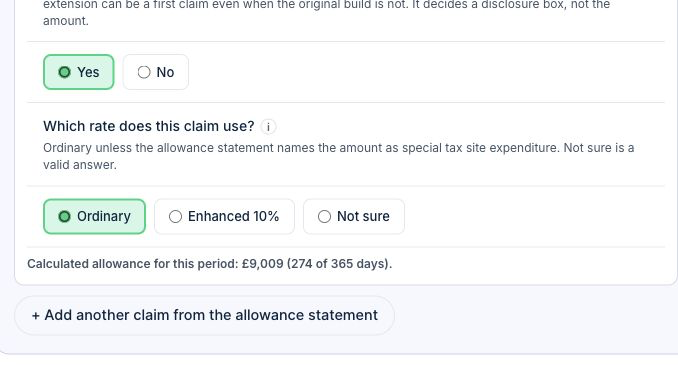
- “Which rate does this claim use?”, shown when your period dates allow the enhanced rate. Ordinary unless the statement names the amount as special tax site expenditure. Choosing enhanced stops the filing, because that claim needs supplementary pages we do not produce, and “Not sure” stops it too, so you can check rather than guess.
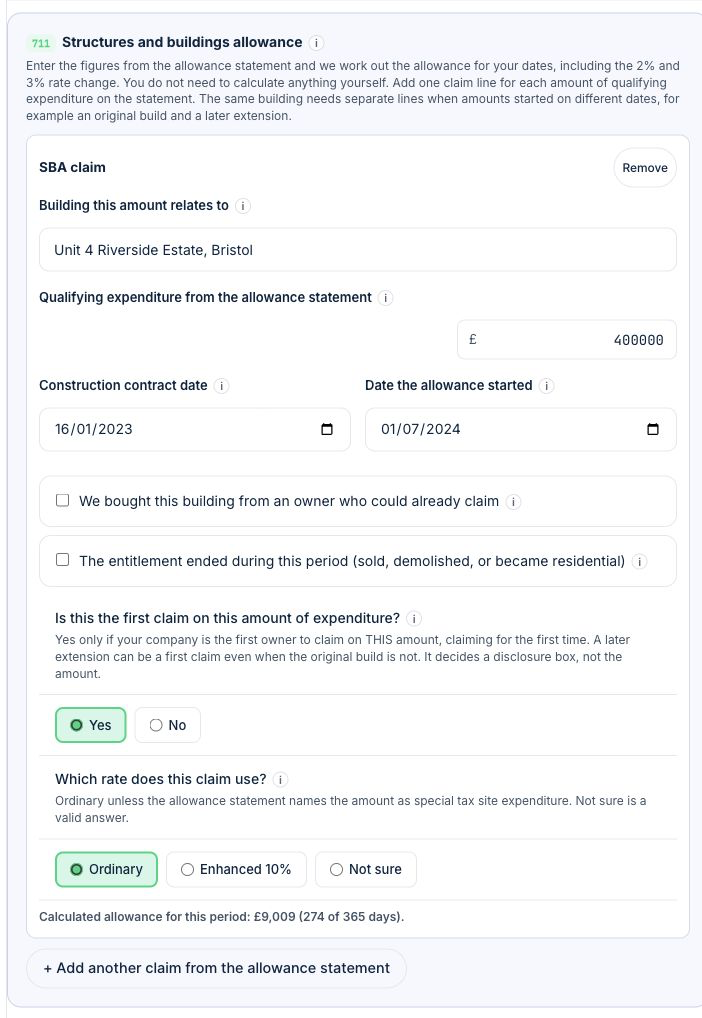
We then show the calculated allowance under each claim line, and file it in box 711 of the CT600. Where the period spans the 2% and 3% rates we work each rate span out separately and round each one up to whole pounds, which is exactly how HMRC presents its own worked example. If your first accounting period is longer than 12 months and files as two returns, we show and file each return’s own figure, worked out from its own days. The allowance is additional to the equipment fields, not an alternative to them. If the company also bought computers, tools or a van, claim those in their own fields as usual and add the building here on top.
Why we ask for the building cost every year
We ask for the qualifying expenditure on every claim, not just the first one, because the allowance is a percentage of it: the cost is the figure the whole calculation rests on. A later claimant still has it to hand, because the allowance statement that passes with the building carries the original cost (HMRC’s Capital Allowances Manual, CA94650).
Box 771 is a separate matter. That box prints the qualifying expenditure once, from a first claimant making a first claim, which is what the first-claim question decides. When a long first period files as two returns, we make that disclosure on the first return the claim accrues in and not again. The question and the box are two different things. We always need the cost for the calculation, and box 771 only carries it on a first claim.
A rule of thumb for sense-checking the statement against the figure we show: at 3% the cost is roughly 33 times the yearly allowance, at 2% roughly 50 times, and at the enhanced 10% special tax site rate 10 times.
Part-year use, and buildings that stood empty
The allowance accrues only while the building is in qualifying use. It builds up day by day from the date the allowance started, the later of the building first coming into non-residential use and the spending being incurred. Because you give us that date from the allowance statement, a building first used part way through the year gets a part-year figure automatically. We used to ask a whole-period use question and refuse anything but a yes. The dates replaced it, so part-year claims now file normally.
A building standing temporarily empty keeps accruing the allowance, as HMRC’s Capital Allowances Manual, CA93110 confirms, so you do not need to tell us about empty spells between tenants or uses. What does stop the allowance is the entitlement ending: a sale, demolition, or the building becoming residential. Tick the entitlement box and give the date, and the calculation stops there.
The allowance statement
You cannot claim the allowance at all without a written allowance statement. It records the building, the date it first came into qualifying use and the qualifying expenditure. It does not record your yearly claim: that is calculated from the qualifying expenditure at the rate for the dates, which is exactly what we now do for you from the figures you copy in. Whoever incurred the construction cost prepares the statement, and it stays with the building for the life of the claim.
When the building is sold, the statement passes to the buyer with the building, so the buyer can carry on the remaining years of the claim. If you bought a building part-way through its 33 and a third years, ask the seller for the statement before you claim anything, and tick the previous-owner box on the claim line so you can give us the date the allowance period originally started. Your claim then runs to the end of the original period, not a fresh 33 years from your purchase.
What we do not work out for you, and why
- We do not check the statement itself. We calculate from the statement facts you supply and do not verify eligibility. The calculation is only as good as the cost and dates you copy in, and checking whether the underlying spending genuinely qualifies is accountant territory.
- We do not handle the sale-year gain adjustment. The allowances you claimed feed into the chargeable gain computation when the building is sold, and that is accountant territory. Recording the sale date here only stops the allowance accruing.
- We do not file the enhanced 10% special tax site claim. It needs the CT600M supplementary pages, which we do not generate. We recognise the claim and stop, rather than quietly filing it at the ordinary rate.
- We do not split a mixed-use building for you. If one statement covers parts with different facts, for example two entitlement histories, enter them as separate buildings with their own figures, or ask an accountant.
For a straightforward yearly claim, your allowance statement plus the GOV.UK guidance is usually enough. For anything else, speak to an accountant.
Related articles
- Capital allowances: what to enter covers the equipment fields that sit alongside this one.
- Why we cannot work out your Corporation Tax explains the blocking checks, including the retired whole-period message that can still appear when an older saved draft is reopened.
- Long first accounting periods: fully supported for this allowance. A first period longer than 12 months files as two returns, and we work out each return’s own share from the statement dates, with the building cost disclosed once on the first return the claim accrues in. There is nothing for you to divide.
This article is general guidance, not tax advice. Structures and buildings allowance claims turn on the paperwork and the dates, and the sale-year consequences reach into chargeable gains. If you are unsure, check the GOV.UK guidance or speak to an accountant.