Loan write-offs and current-period non-trading deficit claims
Short version. Use this guide to enter a qualifying non-trading loan write-off or choose a current-period non-trading deficit claim. A qualifying debit enters the non-trading loan relationship calculation. A claim against this period’s profits is optional. Leave the claim blank for the calculated maximum, enter a smaller amount to claim part, or 0 to claim nothing now.
Go to the steps and entry details
On this page
CT600 boxes 260 and 795One or two returnsWhere you see it: Financial Data › Non-trading loan write-offs
Use this guide to enter a qualifying non-trading loan write-off or choose a current-period non-trading deficit claim.
- The accounts charge for a write-off stays in Depreciation and amounts written off assets. The write-off field identifies its qualifying Part 5 non-trading debit without adding it back twice.
- The write-off field covers a qualifying impairment of a company’s loan receivable. A loan the director made to the company, a trading loan debit and a customer invoice bad debt use different treatments.
- Box 795 reports the net deficit arising after taxable non-trading loan credits. Box 260 reports the current-period deficit used. Box 263 reports brought-forward relief used.
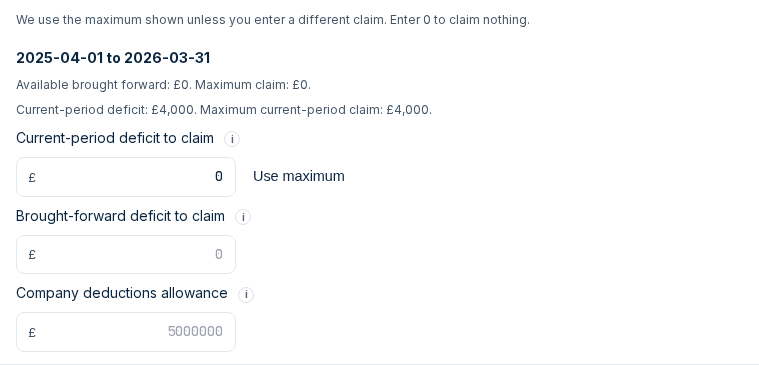
If your deficit comes from interest or exchange differences, keep those amounts in their existing fields and use Current-period deficit to claim. Leave Non-trading loan write-offs blank when there is no qualifying write-off.
Is this the right option for you?
Use it if all of these are true
- You have a qualifying loan write-off in the accounts depreciation row, or a current non-trading deficit from interest, exchange differences or other qualifying debits.
- Your prepared tax computation identifies the qualifying amounts and the claim you want to make.
Do not use it if
- You need to classify a gain from a director waiving a loan owed by the company.Use instead: Director loan waivers
- You only need to enter an opening deficit balance.Use instead: Brought-forward non-trading deficits
An accounting write-off alone does not establish tax relief. Connected-company impairment and releases are generally excluded, with statutory exceptions. Connection at any time in the accounting period matters. CTA 2009 section 321A excludes a release or write-off debit where the loan was subject to the participator-loan charge, including the extended rules. This is not every loan to a director or shareholder. Section 441 excludes the portion attributable to an unallowable purpose on a just and reasonable basis.
Common mistake: leaving the claim blank to preserve the deficit
Blank uses the maximum. To claim nothing now, enter 0 in Current-period deficit to claim. A smaller claim preserves only the unused balance. Do not move a loan write-off into interest payable to obtain relief.
Blank claim when intending to preserve it
- Claim
- Calculated maximum
- Corporation Tax
- £1,140
Explicit nil current-period claim
- Claim
- 0
- Corporation Tax
- £1,900
Worked example
- Company
- Rowan Example Ltd
- Turnover
- £10,000
- Accounts depreciation and write-off charge
- £4,000
- Qualifying non-trading loan debit
- £4,000
The company and all figures on this page are fictional.
The example assumes the whole debit qualifies, no loan credits and no other reliefs. The nil claim leaves the deficit unused. It does not create a trading loss.
Before you start
- Accounts
- Your prepared accounts. A write-off entered here must already be in the depreciation and write-off row, including any property depreciation
- Tax classification
- Qualifying whole-pound Part 5 debit and any taxable loan credits
- Claim decision
- Maximum, partial or nil for each return
The company and all figures on this page are fictional.
Step by step
Company Profile & Period
- Accounting period
- 1 April 2025 to 31 March 2026
- What are you filing?
- HMRC CT600
- Trading status
- Active
- What the company does
- Trading
Financial Data
- Previous year
- Your previous accounts figures, or 0 where applicable
- Turnover
- £10,000
- Cost of raw materials and consumables
- 0
- Staff costs
- 0
- Other charges
- 0
- Depreciation and amounts written off assets
- £4,000
- + Show all adjustment options
- Open the additional adjustments
- Non-trading loan write-offs
- £4,000
- Current-period deficit to claim
- 0Claim nothing now. Clear the amount to use the maximum instead.
- Balance sheet
- Your prepared balance sheet at the period end
- Average number of employees
- Your average number, or 0
Review & file
Corporation tax due£1,900 .00On taxable total profits of £10,000 at 19.0% · small profits
For a property-only company, use the gross figures in Property income and expenses and include the accounts charge in its depreciation row. Open the additional tax adjustments if the write-off option is collapsed. Enter the qualifying subset in whole pounds. Together with the Part 8 amortisation or impairment deduction, it cannot exceed the combined trading and property depreciation charge, rounded to the nearest pound. Review the calculated maximum and unused balance before filing. The review separates the actual current-period relief used from its signed reconciliation. Write-off figures marked as a memo are already included in the loan calculation.
A same-period claim may cover all or part of the deficit. The normal claim deadline is two years after the end of the deficit accounting period, subject to HMRC’s power to allow later claims. Current-period deficit relief takes priority over current trading and property loss relief. A smaller claim can leave tax unchanged where automatic trading or property loss relief uses the freed profits instead. Review which unused pool remains. This guide does not make a carry-back or group-relief claim.
Accounts periods over 12 months
Confirm which return receives the debit using the allocation beside Non-trading loan write-offs. The initial suggestion puts it all in return 1. Replace that suggestion with your prepared allocation. The accounts depreciation still follows the accounts split. With separate figures, enter each return’s own charge and qualifying subset.
Each return has its own current-period claim. Return 2 also receives the unused eligible balance from return 1. To preserve the whole balance, enter 0 in the current-period claim and the brought-forward claim on both returns. A zero brought-forward claim alone does not prevent return 2 from claiming its own new deficit.
Sample outcome
Unused eligible amounts can carry forward subject to the statutory conditions. Using a carried-forward deficit against total profits needs a claim and has further conditions, including investment-business continuity. Where that business became small or negligible, a non-trading-profits-only route can apply. The deductions allowance restricts relief used against later profits. It does not cap the balance carried forward. This service’s existing brought-forward route does not cover every restricted pool.
Not the right option?
Open the guide for the option that matches your filings.
Looking for a different field or step? See all filing wizard guides →
Official sources
- HMRC CFM35320: impairment and connected companies
- HMRC CFM32060: current-period claims and priority
- CTA 2009 section 321A: participator-loan write-offs
- CTA 2009 section 348: connection during the period
- CTA 2009 section 354: connected-company impairment
- CTA 2009 section 441: unallowable purposes
- CTA 2009 section 463C: claim deadline
- CTA 2009 section 463G: carry-forward conditions
- CTA 2009 section 463H: small or negligible business
More help:
Whether this route matches your filings is for you to decide, yourself or with your accountant.
Example companies and figures are fictional. Field names match the filing wizard as of 8 November 2026.